7 QC TOOLS FOR QUALITY IMPROVEMENT WITH A STRATEGIC PLAN

“As much as 95 per cent of all quality-related problems in the factory can be solved with seven fundamental quantitative tools.”
-Kaoru Ishikawa, The inventor of Fishbone Diagram
In today’s customer-centric market, quality is an integral factor in the growth and sustainability of any business. Businesses go the extra mile to provide the best and excellent customer experience to ensure customer satisfaction. Hence, efficient quality management which has the highest impact on customer experience is one of the most essential features for any business.
Introduced by Kaoru Ishikawa, the seven basic tools of quality also known as 7 QC tools are very effective in quality management and quality assurance process. So, businesses who want to ensure competitive and excellent quality of their products and services can utilize the proven 7QC tools for structuring a strategic plan for quality improvement.
In essence, these tools help answer three critical questions:
- What Is Going Wrong?
- Why Is It Happening?
- And How Can We Fix It Effectively And Permanently?
The following sections offer a closer look at each of the 7 qc tools of quality with examples and real-world applications.
Want to implement the 7 QC Tools in your organization? Explore our 7 QC Tools services
LIST OF 7 QC TOOLS FOR QUALITY IMPROVEMENT
CAUSE AND EFFECT DIAGRAM
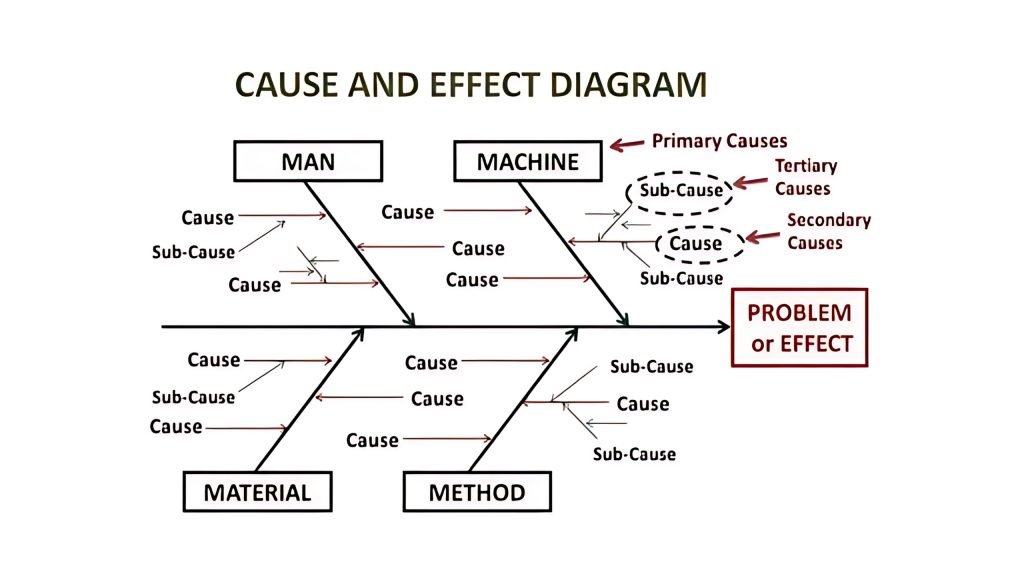
Cause and Effect Diagram also known as Fishbone Diagram helps in identifying the potential causes of an effect or a problem. In addition to sorting ideas in respective categories, it also helps in understanding the areas of opportunity through effective brainstorming. Fishbone training empowers you to identify the potential cause in the problem.
It is most useful when the root cause of a quality issue is unknown, allowing teams to structure their investigation by categorizing inputs like manpower, methods, machines, and materials. The tool supports collaborative analysis and is commonly applied in service delivery, manufacturing, supply chains, and process engineering where problem resolution demands a holistic view of interconnected factors.
Example: A quality assurance team in a pharmaceutical plant uses a fishbone diagram to analyze the root cause of inconsistent tablet weights. Through category-wise analysis, they discover that humidity in the raw material storage area is affecting tablet compression, leading to a procedural and infrastructure correction plan.
CONTROL CHART
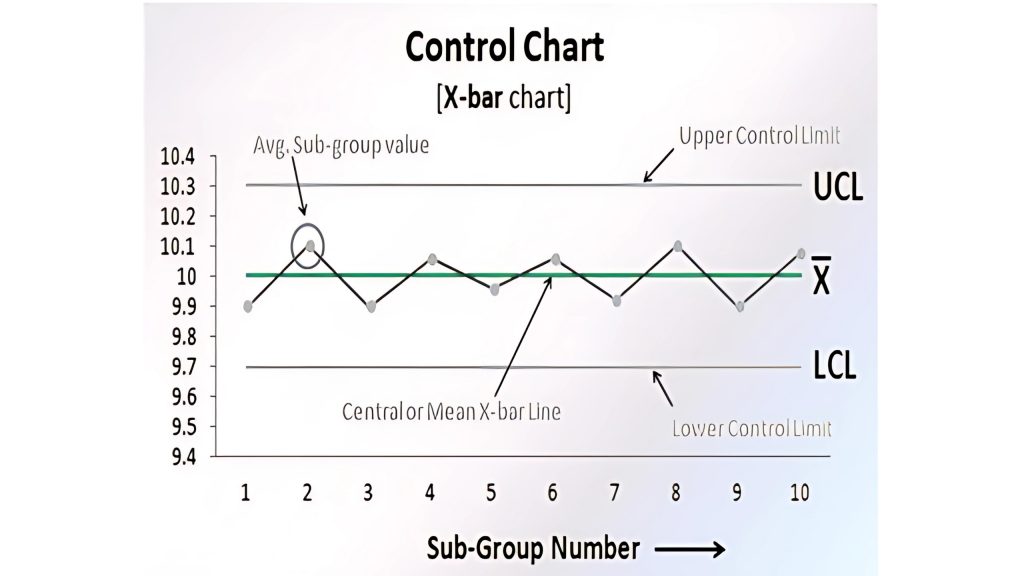
Control charts are used to study how the processes have changed over a period of time. Further, by comparing current data to historical control limits, one could lead to the conclusion about whether the process variation is consistent as in under control or unpredictable as in out of the control due to being affected by special causes of variation.
Control charts are particularly valuable in monitoring performance stability and identifying trends that may signal shifts or abnormalities in a process. They are widely used in Six Sigma, lean manufacturing, and process improvement programs to distinguish between normal variation and signals that require corrective action. This tool is ideal when evaluating time-bound data in areas like production quality, customer service response times, or delivery accuracy.
Example: A food processing unit monitors the weight of packaged products using a control chart. It notices that several recent entries are creeping above the upper control limit, indicating a need for calibration before regulatory weight thresholds are breached.
PARETO CHART

Pareto Chart is based on the 80/20 rule where it shows the significant factors that have the highest impact on the identified problem. This tool helps prioritize issues by highlighting the most frequent or impactful causes from a range of contributing factors. It is especially useful during the analysis phase of quality improvement projects when teams need to allocate resources effectively. Pareto Charts are commonly applied in complaint analysis, defect tracking, and operational efficiency reviews to drive focused action on areas that yield the highest benefit.
Example: A telecom company uses a Pareto chart to evaluate reasons for service downtime. It finds that 75% of outages are due to just two causes: fibre cuts and server overloads—prompting infrastructure upgrades in those areas.
CHECK SHEET
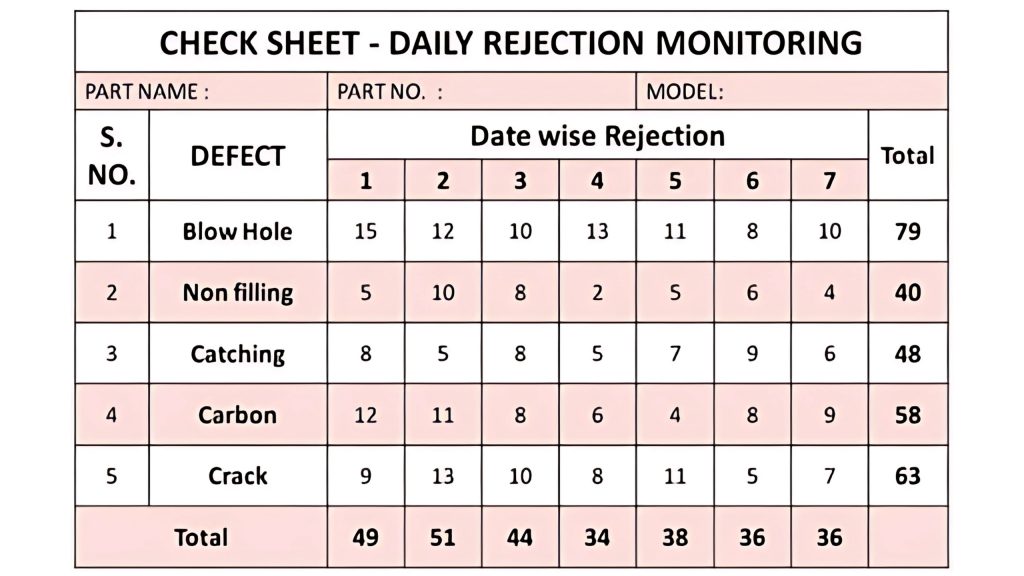
Check sheet is a structured process which helps to collect and analyzing data. It is an effective tool that can be for a variety of purposes. Often used as a data collection template, the check sheet helps operators and teams capture real-time information directly from the source. Its simplicity makes it ideal for frontline usage in production, maintenance, audits, and inspections. Whether tracking defects, documenting process steps, or recording equipment downtime, check sheets make trends easier to identify and prepare the data for further analysis.
Example: In a textile manufacturing unit, a quality inspector uses a pre-designed check sheet during an 8-hour shift to note every occurrence of fabric defects like misprints or loose threads. At the end of the week, the data reveals that nearly 65% of defects occurred in one section of the loom—prompting a focused maintenance review.
Need expert guidance on quality improvement and process control? Contact Us our experts Now!
HISTOGRAM
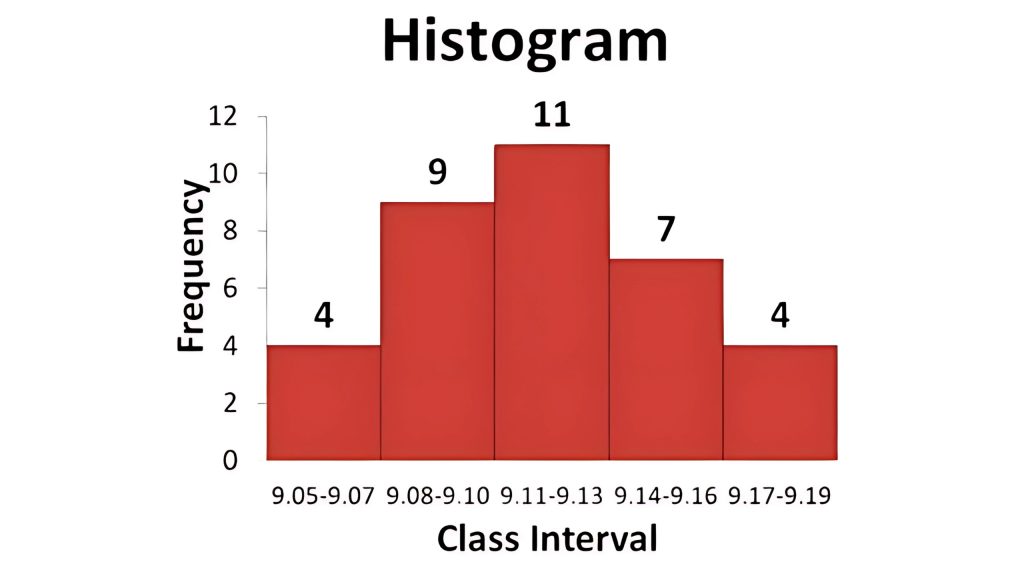
Histogram is commonly used a graph that shows the data and its frequency of distribution to help users identify each different value in a set of data occurs. Histograms help teams visualize whether process outputs are meeting expected performance standards or drifting outside desired ranges. They are especially effective when analyzing large volumes of continuous data, such as cycle times, service durations, or dimensional measurements. By revealing the shape and spread of data distribution, histograms support decision-making in quality control, product standardization, and process capability assessments.
Example: A manufacturing plant records the diameter of 500 metal rods produced in a day and creates a histogram. The graph shows that most values are slightly below the target range, indicating a systematic issue in the cutting machine’s calibration.
SCATTER DIAGRAM
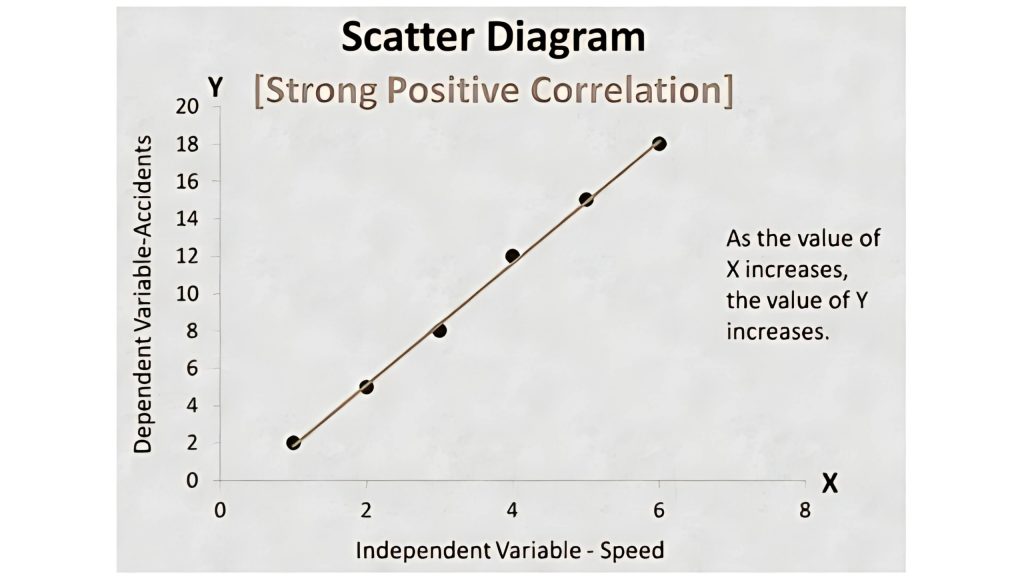
Scatter diagram shows the relationship between two important factors i.e. pairs of numerical data, one variable on each axis to demonstrate the relationship.
This tool is instrumental in verifying suspected correlations between two variables, such as input parameters and resulting output. By plotting real data pairs, teams can visually assess the strength and direction of relationships, which is crucial during root cause analysis or experimental studies. Scatter diagrams are frequently used in quality control to validate process assumptions, optimize parameters, and detect potential causal factors in performance deviations.
Example: A facility manager examines the link between machine operating hours and the number of breakdowns using a scatter diagram. The chart shows a clear upward trend, confirming that machines with longer hours are more prone to failure, justifying a revised maintenance schedule.
STRATIFICATION
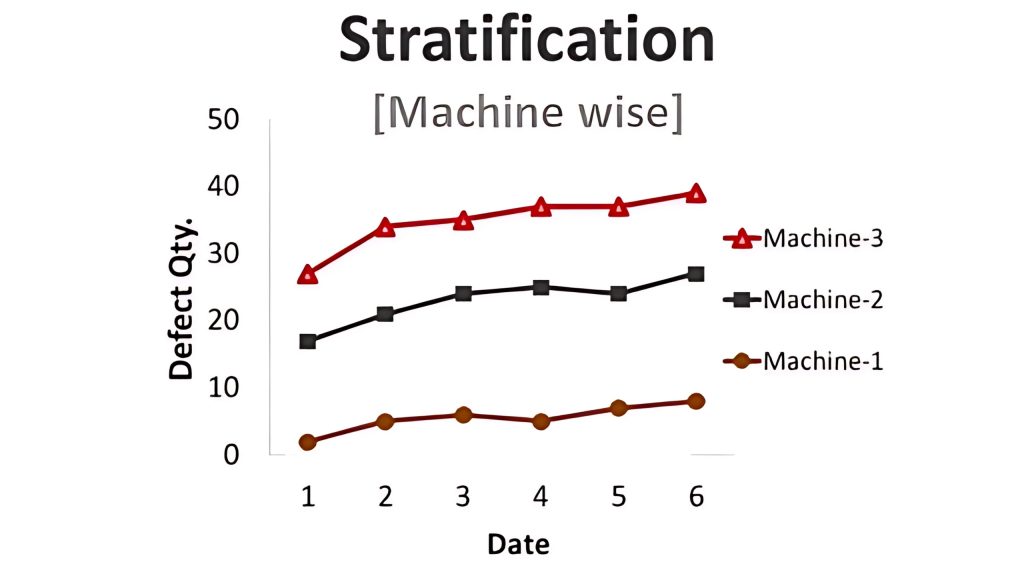
Stratification also known as a flow chart or run chart is a technique that separates the data gathered from a variety of sources so that patterns can be seen i.e., the path an entity has taken through a defined process. Utilizing the 7 QC tools in six sigma or quality management process helps in taking a systematic approach to identify and understand the risk, assess the risk, control fluctuation of product quality and accordingly provide solutions to avoid future defects.
It becomes especially valuable when dealing with mixed data from various departments, time frames, operators, or equipment. By organizing the data into meaningful categories before analysis, Stratification enables clearer comparison and avoids misleading conclusions. It is commonly used in audits, supplier evaluations, customer feedback analysis, and performance monitoring to trace underlying trends across segmented data sets.
Example: An electronics company investigates a rise in product rejections and stratifies the data by production shift. It reveals that 80% of the rejections occur during the night shift, leading to a focused training intervention for the night crew.
WHEN SHOULD YOU USE 7 QC TOOLS?
7 QC tools can be carried out during the quality management, quality improvement process, six sigma implementation processes or even the regular PDCA cycle for the quality purpose for enhanced quality management.
In the first phase of measuring and identifying, Fishbone Diagram also known as cause and effect diagram, Pareto Chart and Control Chart can be utilized. In the next phases of assessment and analysis, Scatter Diagram, Histogram and Checklist can be carried out. The Control Chart can be utilized consistent quality improvement.
BENEFITS OF 7QC TOOLS
The 7 QC tools are structured and fundamental instruments that help businesses improve their management and production process for achieving enhanced product quality.
From assessing and examining the production process, identification of key challenges and problems to controlling the fluctuation present in the product quality and providing solutions for prevention of defects in future, the easy to understand and implement, 7 QC tools are very effective. Some of the major business benefits of 7 QC tools are listed below.
- Provides a more structured path for problem-solving and quality improvement
- Easy to understand as well as implement yet extremely effective
- A scientific and logical approach for problem-solving
- Follows the 80/20 rule i.e. gain 80% result with 20% efforts
- Improve the quality of product and services
- Helps in identifying and analyzing problems during the process
- Fishbone training aides in root cause analysis and problem-solving
- Encourages team spirit and fosters a healthy culture
- Identifies roots cause and solve it permanently
- Enhance customer experience and customer satisfaction
Based on the data-driven process and customer-centric approach, 7 QC tools implementation is one of the most effective processes that too in the shortest amount of time.
HOW 4C CAN HELP YOUR ORGANIZATION UNDERSTANDING 7QC TOOLS?
4C Consulting’s team of certified professionals brings hands-on expertise in deploying the 7 QC tools across diverse industries. With 80+ successful implementations and 120+ specialized training programs conducted, we have helped organizations integrate these tools into their quality systems with confidence and clarity. Our structured, data-driven approach has enabled clients to solve over 200 quality-related problems—reducing up to 80% of the cost of poor quality. From conducting root cause analysis and setting up effective control charts to enabling frontline teams with check sheets and Pareto prioritization, we ensure your organization is equipped for sustainable improvement.
Want to accelerate your quality management journey and reduce operational waste? Partner with 4C Consulting to unlock the full potential .

Comments
Post a Comment